Well, They Don’t Need To Know Why.
The Pattern Before Chi Alpha.
Long before Daniel Savala, the Assemblies of God knew why a minister was dismissed and never told the next church. A judge awarded $82 million for the silence, likely the most expensive mistake in their history. This is that case, in the denomination's own words, under oath.
By Ron Bloomingkemper, Jr. | September 13, 2026
Did you know the Assemblies of God's South Texas District lost a sexual abuse case so badly that a judge awarded $82 million in damages?
The abuse itself dates back to the 1990s.
The reason it happened at all is what this piece is about, and it looks a lot like the pattern NBC News has spent its Pastors and Prey investigation documenting across fifty years of the same denomination:
a minister accused of molesting children, a file that stays inside the church, and silence that gets justified as protecting the institution rather than the kids inside it.
What you're looking at
Two major documents accompany this piece: the original August 1999 letter from Howard Burroughs, then superintendent of the South Texas District Council of the Assemblies of God, to Pastor Robert Parr, and the full depositions and transcript from the lawsuit that followed, 118 pages of sworn testimony from Burroughs and others, taken under oath in 2001.
Neither one is easy reading on its own.
Legal filings run long, use unfamiliar terms, and bury the important parts in pages of procedure.
This article guides you through both documents: what they say in plain language and exactly where to find the parts that matter if you want to check them yourself rather than take a reporter's word for it. A page-by-page guide to the deposition is at the end of this piece.
The Letter
On August 20, 1999, Howard Burroughs, superintendent of the South Texas District Council of the Assemblies of God, wrote a letter to Robert D. Parr, pastor of Little Rock Assembly of God Church in Kountze, Texas. The letter confirmed a phone call from four days earlier and got straight to the point: Parr was, in Burroughs' words,
"leaving yourself open to at least a lot of criticism, and perhaps even worse if the word is out about the serious nature of the charges that were brought against David Wells in 1994."
Exhibit A: Howard Burroughs' August 20, 1999 letter to Pastor Robert Parr, filed as evidence in the Wells litigation.
Burroughs then cited Article IX, Section 10 of the denomination's own bylaws, titled "An Improper Attitude Toward Those Removed From the Fellowship." He quoted it in full: local churches "shall refrain from taking an attitude toward offenders that would tend to nullify or set at naught the solemn verdict of the brethren entrusted with this responsibility," and anyone who fails to fall in line "shall be subject to reprimand or, if persisted in, appropriate discipline."
Then Burroughs wrote the line that matters most:
“Nobody who has been disciplined by the Assemblies of God should be employed as a minister by any of our churches.”
David Wells was, at that moment, the youth minister at Little Rock Assembly of God Church. Parr was his father-in-law.
According to a lawsuit filed against both men and the denomination itself, Wells would sexually assault two more children within the few years preceding the letter.
What the verdict established
The Houston Chronicle didn't have to guess at the broad strokes of what happened next.
In 2002, State District Judge Donald Floyd awarded $82 million to two young plaintiffs, a 14-year-old boy and his 16-year-old sister, who said Wells assaulted them between 1997 and 1999 while he was youth minister at the Kountze church: $6 million in compensatory damages and $35 million in punitive damages for each of them.

According to the attorney involved in the case, the judge decided this alone rather than sending it to a jury after opposing counsel missed the deadline to request and pay for a jury trial.
That detail comes from the attorney's recollection rather than the Chronicle article itself and hasn't been independently confirmed against the trial docket, but it matches the Chronicle's language at the time, which describes the judge ruling on damages rather than a jury returning a verdict.
By then, Wells had already pleaded guilty to sexually assaulting a child while serving as youth minister at the Kountze church and had been sentenced to 10 years' probation.
He was in the Hardin County jail on a motion to revoke that probation when the Chronicle reported on the verdict.
J. Shelby Sharpe, the attorney representing the South Texas District Council, confirmed on the record that the district had stripped Wells of his ministerial credentials back in 1994 over similar allegations at a Houston church, and that Wells was, by the district's own rules, barred from serving as a minister at the time he was assaulting the two Kountze children.
Layne Walker, the attorney for the two youths, said the district never told the Kountze church about the earlier accusations.
The attorney interviewed said the local church was dismissed from the lawsuit before trial because, as a matter of law, the judge found the allegations could not be sustained against it because there was no evidence it knew of Wells’ past allegations.
The South Texas District Council announced it would appeal.
Those are the facts a court and a newspaper put on the record: the credential was pulled in 1994, the ban on ministry was real, and the assaults that produced an $82 million verdict happened anyway, at a church that the court determined was never told why Wells had been removed in the first place.
What the petition alleged, and what the depositions confirmed
The petition describes a specific chain of decisions, made by specific named people.
Some of what it alleges is still just allegation.
But sworn testimony taken from Burroughs, from Wood, and from the denomination's own in-house lawyer, filed as exhibits when the case reached summary judgment in 2001, moves several of the same claims from "the plaintiffs say" to "the men involved admitted under oath." Here's what happened, laid out in order, with each piece marked by its actual source.
Twelve people put it in writing, starting in early 1994.
The complaints against Wells didn't arrive as a single report. According to Burroughs' own file, the first word reached him in February 1994 through a chain that ran from a pastor in Houston, Richard Rodriguez, up through a sectional presbyter, Tom Shepherd, to Burroughs himself.
A note in Burroughs' file, dated February 3, 1994 and later marked as a court exhibit, has him instructing his secretary to hold Wells' credentials rather than let them renew automatically while the investigation continued.
Over the following months, twelve separate written complaints accusing Wells of sexually molesting young people accumulated in his file.
Burroughs testified he didn't know exactly what all twelve described, but understood the pattern well enough to write "hold David's credentials" on the note.
Exhibit 16: the note in Burroughs' own file, February 1994.
The abuse went back further than Houston, and Burroughs was told, by his own account, in 1994.
Under questioning, Burroughs was also asked about an earlier, separate set of reports from around 1990 involving two other boys and a different section of the district in the Yoakum/Corpus Christi area.
He testified he didn't recall being told about that one at the time.
Whether or not that specific report reached him personally, it establishes that allegations involving Wells and children predate the 1994 Houston complaints by roughly four years, consistent with the petition's claim that the pattern went back to at least March 1990.
The district followed its own internal process, and only its own internal process.
Wells was called to a hearing in May 1994, didn't show up twice, and was formally dismissed "on charges of conduct unbecoming a minister" on July 19, 1994.
Burroughs signed the letter revoking his credentials the next day.
That process ran entirely inside the church.
Nobody, at any point, called the police, Child Protective Services, or any outside authority about the twelve complaints.
When asked why not, Burroughs said he assumed the matter was already "playing its way out" through the church's own hearing process, and separately testified that he believed the families and Rodriguez had already handled outside reporting themselves.
The General Council's own in-house counsel, Richard Hammar, testified in the same case that if Burroughs had reasonable suspicion that a child had been abused and knew who the victims were, Texas law created "a duty to report," and that he personally would have advised Burroughs to make that report.
Hammar also testified that the same set of twelve complaints reached George Wood's desk at the General Council's Missouri headquarters on July 26, 1994, and that Wood didn't report them either, assuming Texas had already done so.
Wood's own office for legal counsel, where Hammar worked, was a short walk from his own; nobody made that walk.
South Texas AG Superintendent Howard Burroughs warned Parr in 1994, but only once, by phone, and vaguely.
Burroughs testified that in the summer of 1994, after Wells' credentials were pulled, he called his father-in-law directly and told him that
"David's credentials had been removed for very serious allegations... and that he had heard that David was up there with him and that he needed not to allow him to be working in the church."
What Burroughs' own testimony does not show is that he ever told Parr the allegations involved sexual abuse of children specifically.
Pressed later in the deposition on whether Parr knew the actual substance of the charges against his son-in-law, Burroughs said he didn't know:
"If he knew them, he didn't know them from me."
Parr, according to Burroughs, said Wells wasn't employed there, was working at a Dairy Queen, and no longer had an interest in ministry.
Burroughs testified he never followed up to verify that.
He didn't check with the section's youth leader.
He didn't call Parr again to ask how Wells was doing.
In October 1996, Burroughs personally visited Little Rock Assembly of God Church as a guest speaker for its homecoming service, spent the day there, and testified that Wells' name simply never came up.
By that point, records show Wells had been listed as a member of the church since 1996, the same year the petition alleges he became its youth director.
Howard Burroughs' deposition, pages. His own words: a direct 1994 warning to Parr, and a 1996 visit where he never asked.
That distinction between "very serious allegations" and an actual description of what Wells had been accused of doing is a real complication in the plaintiffs' theory. What Parr actually knew, versus what the district knew, mattered a great deal in how this case was resolved, as the section below explains.
“Parr never learned that the charges involved sexual abuse at all, only that Wells had lost his credentials. It was that gap, what Parr actually knew versus what the district knew, that got the church itself dismissed from the lawsuit.”
A phone call from a deacon, not district oversight, reopened the question in 1999.
Burroughs testified that in August 1999, a member of the Little Rock church's board of deacons called him, unprompted, to ask a direct question: had Burroughs ever told Parr that Wells couldn't be used in ministry?
Burroughs said yes, and immediately called Parr himself, angry and "disappointed."
Parr's response, in Burroughs' own retelling, was that Wells "was not ministering there in the church, that he was just helping out occasionally," working with young people because the church was short-staffed:
"People criticize, but they won't work, and he's just stepped in there because I couldn't get anybody else."
Parr assured Burroughs that Wells was never alone with children.
Burroughs testified he warned Parr again that his ministry, and possibly his pastorate, could be at risk if word got out.
Two days later, he wrote the August 20 letter reminding Parr about Article IX, Section 10, the bylaw against criticizing decisions made about removed ministers.
Burroughs also did not report anything to police in 1999.
According to the petition, the two children at the center of the eventual $82 million verdict were assaulted between 1997 and 1999, which means the window when Wells had access to them at Little Rock overlaps entirely with the three years Burroughs went without checking on him.
Parr's excuse and Burroughs' own explanation for the letter
The bylaw, read closely
Set the allegations aside for a second and just read the bylaw Burroughs quoted in his own letter.
Article IX, Section 10 isn't a child protection rule. It isn't a reporting requirement, a background check policy, or a disclosure standard for churches considering a hire.
It's a non-disparagement clause for the institution itself: it exists to punish a minister who publicly questions or undermines "the solemn verdict of the brethren" about someone who's already been removed.
It protects the process from criticism. It says nothing about protecting the next congregation from the person the process removed.
That's the real subject of Burroughs' letter to Parr, too. Even here, at the one moment Burroughs put anything in writing, he never spelled out what Wells had actually been accused of.
“The letter refers only to “the serious nature of the charges that were brought against David Wells in 1994,” the same vague phrasing Burroughs says he used on the phone five years earlier. It doesn’t say sexual abuse. It doesn’t say children.”
What Burroughs is warning Parr about, in the one document this reporting has in his own hands, is liability and criticism:
"leaving yourself open to at least a lot of criticism, and perhaps even worse if the word is out."
The letter is dated August 1999. The Kountze assaults, according to the plaintiffs, were already underway.
If Parr genuinely never learned what "the serious nature of the charges" meant, as the attorney's account holds, that vagueness wasn't a one-time lapse.
It was the same word choice, repeated across five years and two separate warnings, and it left the one man in a position to stop Wells' access to children without the one fact that would have told him why he needed to.
"It just says 'dismissed'"
This is the part that gets at the actual mechanics of the cover-up culture, straight from Burroughs' own deposition, and it's the strongest source this series has for the disclosure argument.
The South Texas District put out a monthly newsletter to its ministers.
The General Council in Missouri separately put out a quarterly letter listing which ministers had lost their credentials.
Burroughs was asked directly whether he could have used either one to warn other Assemblies of God churches about Wells.
Asked if he could have put a notice in his own district newsletter that Wells had lost his credentials over allegations of sexual misconduct, Burroughs said no:
"We just never do that in the newsletter."
He testified that information instead goes out only in the General Council's quarterly letter, in a much narrower form.
Asked directly whether that quarterly letter explains why a given minister lost his credentials, Burroughs testified that it does not.
“It lists names under the word “dismissed” and nothing else. A minister removed for molesting children appears on the same list, described the same way, as a minister removed for failing to pay annual dues.”
Pressed on why the General Council couldn't simply say, in writing, that a specific minister had lost his credentials over allegations of sexual misconduct against children, Burroughs pointed to the denomination's own lawyers:
he said headquarters has attorneys who "run around scared with all charges and allegations," and would likely be too wary of liability to put something like that in print.
When it was put to him that the alternative, saying nothing, leaves every other Assemblies of God church with no way to know why a minister they might hire was let go, and that Wells was free to walk into any of them, Burroughs agreed the risk was real.
Asked whether protecting the denomination's youth mattered more to him than the risk of a defamation suit, he answered, "Well, of course."
He also acknowledged that whether the church even had the legal right to publish the reason for a dismissal was a question he genuinely didn't know the answer to, since he wasn't sure disciplinary findings counted as public record.
That's the system in its own words, from the man who ran a district of it for eighteen years:
a minister's file can hold twelve written complaints of child sexual abuse, the district can know exactly why he was removed, and the only thing that follows him into public view is the word "dismissed," indistinguishable from a paperwork lapse.
Nothing required Little Rock Assembly of God to be told.
Nothing required any other Assemblies of God church, anywhere, to be told either.
No specific line in this record has anyone saying outright that the public has no business knowing why a minister was dismissed.
What the record has instead, from Burroughs' own mouth, is something closer to that in practice:
a standing policy of never saying why, dressed up as routine newsletter procedure and justified, when pressed, by fear of a lawsuit rather than concern for the next congregation.
But this wasn't just one district superintendent's personal habit.
It went to the very top of the denomination, and there, someone finally said the quiet part out loud.
"They don't need to know why"
George Wood, the General Secretary of the General Council, one level below the General Superintendent, confirmed in his own deposition, taken the same day as Hammar's, that he had personally reviewed a number of letters accusing Wells of inappropriate sexual conduct.
He testified that across his seven and a half years in the role, only one or two ministers nationwide were dismissed each year specifically over sexual misconduct allegations involving minors, out of roughly 200 total dismissals annually.
The quarterly newsletter sent to every credentialed minister in the country lists all of them the same way:
"dismissed," with no distinction between debt, adultery, or child abuse.
Asked directly why the newsletter couldn't add a category specifically for ministers dismissed over allegations involving minors, Wood said the denomination had "a fairly well understood policy" that the category doesn't matter once someone is dismissed, because the dismissal itself "carries great weight" regardless of what it was for.
Pressed on the plain fact that a church in Kountze or Beaumont would see Wells listed as dismissed with no way to know why, Wood agreed: "
They have no reason to know why. Correct?" His answer: "Well, they don't need to know why."
The General Secretary of the Assemblies of God, under oath, called this a policy, not an oversight.
“A pedophile and a man behind on his dues appear on the same list, described in the same way, by the Assemblies of God policy.”
Wood went on to confirm that Article IX, Section 10 already barred a pastor from knowingly using a dismissed minister as a volunteer, reading the bylaw into the record himself and agreeing it would have barred exactly what Parr later did with Wells at Little Rock.
And when asked whether Burroughs ever discussed David Wells with him at any point during the 1994 dismissal or after, Wood said no. Not once.
The General Secretary confirmed the "don't need to know why" policy, and the district superintendent spent five years not following up with Parr; they never spoke to each other about the one man whose file both had reviewed.
George Wood states that people don’t need to know why a minister is dismissed.
The failure wasn't limited to one church
Two more admissions from the same deposition, drawn out by the attorney representing Little Rock Assembly of God Church itself, show the disclosure failure extended well past Kountze.
Asked directly whether it would be appropriate for a pastor to use someone as a volunteer with the church's youth group while concealing from his own board of deacons that the person had lost his ministerial credentials, Burroughs testified that it "probably" would not be appropriate, and agreed that a fact like that "should have been made known to the board."
“That’s Burroughs, under oath, conceding that the concealment, wherever in the chain it happened, was wrong by his own standard.”
Then the attorney who represented Little Rock Assembly of God Church asked a broader question:
After Wells resurfaced in 1999 with documentation showing he had since been attending churches in Alabama and Florida, did Burroughs or the South Texas District Council ever contact the district superintendents in either state to let them know a former minister who'd lost his Texas credentials was attending services in their territory?
Burroughs answered in one word: "No."
By then, the district had reopened contact with Wells. It still didn't warn anyone outside Texas.
The failure to disclose wasn't a one-time lapse involving one church; it was the same non-disclosure repeated in a second and third state, years after the district already knew exactly what it was choosing not to say.
What an attorney involved in this case says happened
One of the attorneys in this lawsuit spoke with this reporter about the case twenty-five years after he tried it. His account isn't sworn testimony, and it's offered here clearly marked as his recollection and characterization, not as an independent fact-check of the deposition record.
Where it aligns with the transcript, I note it below.
His summary of what the Burroughs deposition shows matches the record:
"Howard never says he didn't know about the outcry. He says that they couldn't tell anyone at Little Rock because of privacy concerns. And they were afraid of getting sued."
That's consistent with Burroughs' own testimony about the newsletter, the quarterly letter, and the lawyers who "run around scared."
He also filled in a detail the petition and deposition excerpts don't fully spell out: there was never an actual adjudicated finding on the twelve 1994 complaints, because Wells surrendered his credentials before the scheduled hearing ran its course.
In his telling, that resignation stopped the investigation before it produced any formal conclusion, meaning the district's file contains twelve written complaints and a resignation, but no finding.
He also described the theory that got the Little Rock Assembly of God itself dismissed from the case on summary judgment:
“Parr knew his son-in-law had lost his ministerial credentials, but, in the attorney’s account, never knew that the underlying allegations were sexual abuse of children. ”
Burroughs never told him that specifically, on the phone in 1994 or in the 1999 letter, and no one else did either.
That gap, between knowing a credential was revoked and knowing why, is what he says separated Little Rock's board from the South Texas District Council in the eyes of the court, leaving the district alone to answer for the case at trial.
On the outcome, the attorney said the $82 million verdict was not overturned on the merits.
According to his account, the district council appealed to the Ninth Court of Appeals, and the case was ultimately resolved through a mediated settlement for an undisclosed amount before the appeal was decided.
This reporter could not independently confirm that through a public search of appellate records, but that's not surprising: a confidential settlement typically produces no published opinion and little to no news coverage, which is consistent with, rather than contrary to, what he described.
It's noted here as his account and should be treated as unconfirmed until it can be checked against the actual Ninth Court of Appeals docket or the Jefferson County district clerk's file.
He also offered his own view of why this keeps happening, describing what he called a recognizable pattern in how the denomination handles these cases:
“deny knowledge, put the burden on the accuser to prove what leadership knew, keep responsibility on the local church, and lean on the denomination’s congregational structure to insulate the district and the General Council from liability.”
He drew an explicit comparison to how he sees the current Chi Alpha situation playing out.
That comparison reflects his opinion and pattern-matching, based on public reporting on Chi Alpha rather than any direct legal involvement in the matter, and is presented as such.
What the law actually required, and where it got complicated
Burroughs' own reasoning, laid out in his deposition, was that going public risked a defamation suit.
On one specific point, that reasoning gets the law backward. On a second, related point, the denomination's own lawyer says it's more complicated than that, and worth stating precisely rather than flattening into a simple villain-or-hero story.
On reporting to authorities, the law is unambiguous.
Texas Family Code § 261.106 grants immunity from both civil and criminal liability to anyone who, in good faith, reports suspected child abuse.
A person acting in good faith who reports is "immune from civil or criminal liability that might otherwise be incurred or imposed."
Reporting is also mandatory under § 261.101, explicitly including clergy, with professionals required to report within 48 hours of first suspecting abuse. Failing to report is itself a criminal offense under § 261.109.
Richard Hammar, the General Counsel's own in-house counsel, testified in this same case that if Burroughs had reasonable suspicion a child had been abused and knew who the victims were, Texas law created a duty to report, and that he personally would have advised Burroughs to make that report.
On this question, the law did not expose the district to more risk for speaking up to the authorities.
It exposed the district to less.
“Texas Family Code § 261.106: a person acting in good faith who reports suspected child abuse “is immune from civil or criminal liability that might otherwise be incurred or imposed.”
On publicly naming a dismissed minister, the picture is genuinely more complicated, and Hammar says so himself.
Asked directly whether truth would be an absolute defense if Burroughs had simply told Parr the specific reason Wells lost his credentials, Hammar disagreed:
he testified that publicly disclosing private facts about someone, even true ones, can expose the discloser to liability for invasion of privacy, intentional infliction of emotional distress, or interference with contract.
He wasn't defending the district's silence. He was describing a real legal tension between warning people and being sued for the warning, one that has nothing to do with the child-abuse reporting statute above.
That tension doesn't excuse what Burroughs actually did with it.
Hammar testified that Burroughs could have minimized the legal risk simply by asking Wells for permission to discuss the situation with his father-in-law, or by telling Parr the specific truth directly rather than the euphemism he actually used.
Burroughs never attempted either.
Hammar used that exact word, euphemism, to describe the language the district actually did use: "serious charges," he testified, is "a code word" people reach for "for fear of liability," not because the underlying legal question is unanswerable.
“The district didn’t take the safer, lower-risk option of privately telling the one man who needed to know. It chose to say almost nothing to anyone.”
And on the specific question of whether the denomination should simply be required to disclose child molestation dismissals, Hammar's own personal answer is yes.
Asked whether he'd support a bylaw amendment requiring public disclosure specifically when a minister is dismissed for child molestation, as distinct from the wider and vaguer category of "sexual misconduct,"
Hammar said that personally, though he has no vote at General Council meetings, he would favor it. He weighed it explicitly as "protection of the innocent versus privacy," drawing a comparison to the constitutional fights over Megan's Law sex-offender registries, and came down on the side of disclosure.
He also confirmed, in the same testimony, that the Assemblies of God's own bylaws already state that a dismissed minister "is not to be used by any other Assemblies of God church," though he wasn't certain whether that language extended to unpaid volunteer roles, the exact position Wells held at Little Rock.
Richard Hammer Assembly of God former General Counsel.
The reform this piece has been building toward, then, isn't a novel idea being imposed on the denomination from outside.
It's a policy the General Council's own lawyer says he'd personally support, tested against a bylaw the denomination already has and doesn't enforce for volunteers, in a case where the one low-risk step available, telling the father-in-law the truth, was never taken.
Why it matters
The gap that let it happen
A denomination can strip someone's credentials, know exactly why, document it in a file with a dozen written complaints, and still have no mechanism that follows that person to the next church.
Little Rock Assembly of God was never told what the district already knew about the man it made its volunteer youth director. Years later, the board of deacons had to find out on its own and look for answers.
Nothing in Article IX, Section 10 required anyone to tell them, and by Burroughs' own account, nothing in the General Council's actual disclosure practice would have told them either, even if someone had tried.
“That gap, a disciplinary process that produces a real file but no public record, is the specific thing that let David Wells go from Houston to Diboll to Kountze, and then on to churches in at least two more states, over the course of a decade. ”
This series will trace the same gap through Daniel Savala's ministry a generation later.
A church considering hiring someone, or a parent wondering why a youth pastor left his last church, has no way to find out what the Assemblies of God's own leadership already knows, because the denomination's own outside-facing paperwork is built specifically not to say, and because even direct contact with a former minister years later apparently isn't enough to trigger a warning to the next district he shows up in.
Fixing that doesn't require dismantling how a denomination disciplines its own ministers internally.
It requires that when a minister is removed over a child abuse allegation, the reason travels with the credential, in writing, to every church and every district that might encounter him next.
Right now, by design, it doesn't.
The attorney involved in the case said such a requirement can be further protected by having ministers agree, upon accepting their credentials, that if those credentials are ever surrendered or revoked for allegations of sexual abuse or assault, they understand and agree that the facts of their discipline will be disclosed.
A choice, not an accident
What makes this hard to explain away as an old mistake from a different era is that the law never required the total silence Burroughs chose.
Reporting Wells to the authorities was legally protected and mandatory, full stop, and the denomination's own lawyer said so in this very case.
Telling Parr the truth carried more legal complexity, by that same lawyer's testimony, but even then a lower-risk path existed: ask Wells for permission, or simply tell the one man who needed to know.
Burroughs did neither.
He used a euphemism instead, a choice Hammar himself attributed not to genuine legal necessity but to "fear of liability" in the abstract.
What was left, once the legal excuse is examined rather than assumed, is a choice made for its own sake, repeated for years: a file that names twelve complaints, and a decision not to say, clearly, to the one person positioned to stop it, why a man was let go.
“What remains, once the legal excuse is examined rather than assumed, is a choice made for its own sake, repeated for years: a file that lists twelve complaints and a decision not to say clearly to the one person positioned to stop it why a man was let go.”
1997: the reform that died
Whether that decision reflects a considered institutional policy or something closer to institutional reflex, the record shows it was, at minimum, a policy the denomination's leadership considered adopting differently and chose not to.
In 1997, the same year Burroughs was declining to tell Robert Parr the specific truth about his own son-in-law, ministers at the Assemblies of God's biennial General Council meeting in Indianapolis considered a measure to bar anyone convicted of child sex abuse from holding ministerial credentials at all.
After two years of legal review, the denomination's twenty-one ministers in the Executive Presbytery discouraged its adoption, and the measure died.
“Their stated reasoning, as later reported by NBC News: background checks would be expensive, and would not reduce legal liability. ”
The same institutional logic this piece has traced through Burroughs' letter and Wood's deposition, caution measured in legal exposure rather than in children protected, was not unique to one district superintendent handling one case. The denomination weighed it and chose it at the top, in the same years, as a matter of policy.
Twenty-eight years later
That was twenty-eight years ago. In November 2025, NBC News published "Pastors and Prey," an investigation documenting fifty years of sexual abuse allegations and cover-up patterns across the Assemblies of God, prompting the denomination's own pastors to publicly call for reform.
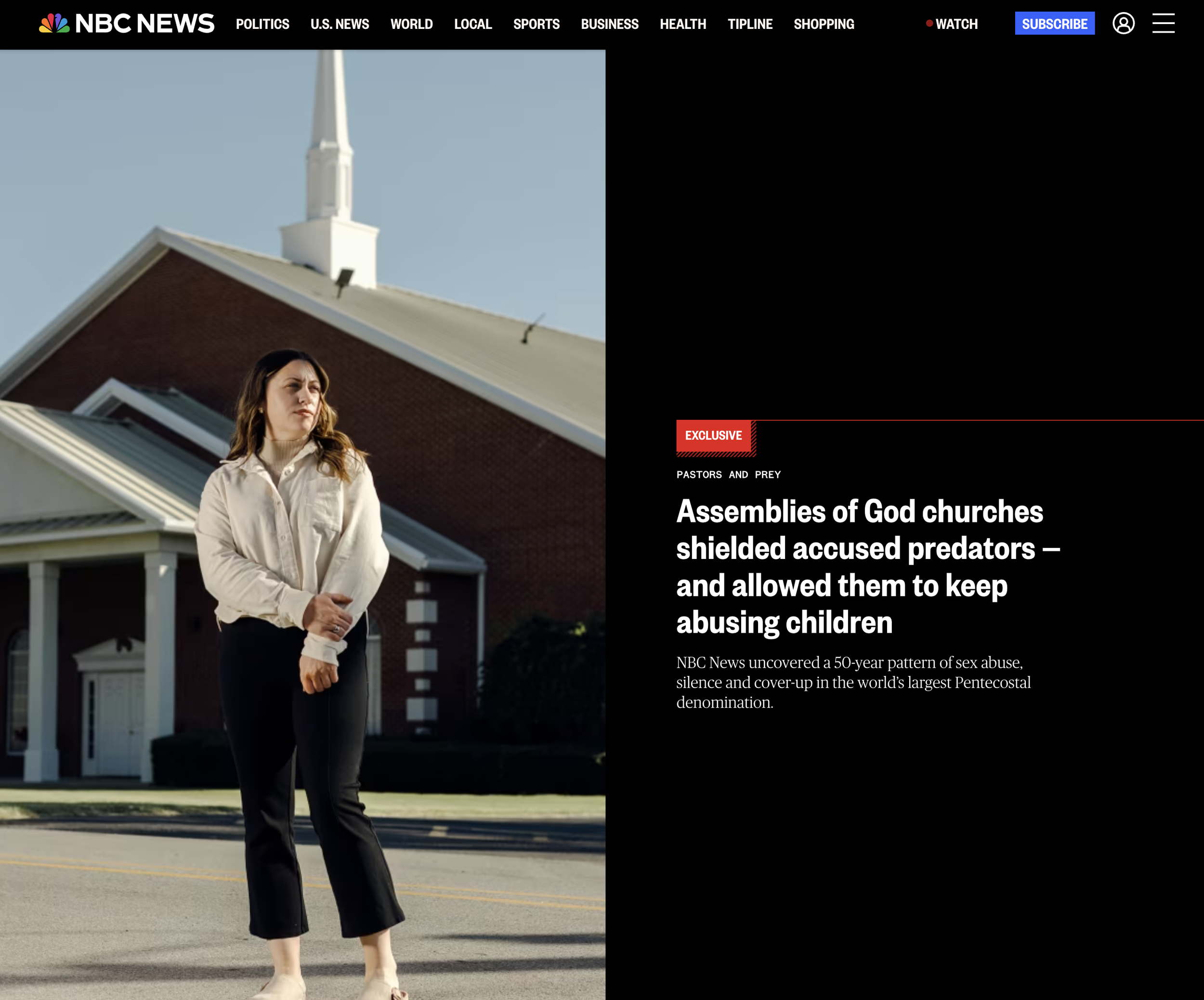
The Assemblies of God responded with an official statement defending its practices: background checks and screenings, it said, are "a well-established part" of its credentialing process, and the General Council "voluntarily considers itself a mandatory reporter."
Nowhere in that response does the denomination address the specific reform this piece has documented: Richard Hammar's own proposal, made under oath in this very case, for a disclosure category that would tell the public, not just the district office, why a minister was actually dismissed.
Twenty-five years after its own lawyer, Richard Hammer, said he'd support it, the Assemblies of God has no public record of adopting it.

Whether that's an oversight or a choice, and whether the pattern in this case mirrors the pattern NBC has now documented in Chi Alpha's handling of Daniel Savala a generation later, are questions this series will keep asking, with its own sourcing, case by case.
What this case alone already establishes, on the record and under oath, is narrower and harder to argue with:
the excuse given at the time, that speaking up was the riskier choice, was not true here, by the denomination's own lawyer's account.
The measure that might have prevented it was considered and rejected in the same years because of cost and liability.
And in a lawsuit that cost the denomination $82 million, what was actually missing was not a bylaw, a statute, or a legal opinion. Burroughs had all three.
“What was missing was one person, anywhere in that chain, willing to say the specific truth to the one man who needed to hear it, and accept whatever it cost to say it. ”
Twenty-five years later, this series keeps returning to the question of whether that person exists yet, and if not, why not.
A GUIDE to the deposition for anyone who wants to check this themselves
The full court document, including multiple depositions, is 118 pages, and most of it is procedural: attorneys stating names for the record, marking exhibits, and taking breaks. You don't need to read all of it to see what's described in this piece. Here's where to find it, using the page numbers printed on the document itself.
Download: Read the full transcript and all depositions (118 pages)
Page 22 — the single most direct line in the whole document: George Wood, the General Secretary of the General Council, testifies that local churches "don't need to know why" a minister was dismissed, describing it as denominational policy.
Page 55 — the actual note in Burroughs' file from February 1994, telling his secretary to hold Wells' credentials while an investigation continued. This marks the start of the paper trail.
Page 65 — Burroughs describes the 1994 phone call to Parr, telling him not to let Wells work in the church.
Page 67 — Burroughs is asked about visiting the Kountze church in 1996 and testifies that Wells' name simply never came up.
Page 70 — the 1999 phone call: a church deacon asking Burroughs a direct question, and Parr's own explanation for why Wells was working with the youth group anyway.
Pages 72–74 — the most important pages in the document for understanding how the denomination's disclosure system actually works: Burroughs explaining that the district newsletter never says why a minister lost his credentials, and that the General Council's own quarterly letter just lists names as "dismissed," with no reason given.
Pages 77–78 — Burroughs is asked whether the district ever warned other states that Wells had lost his credentials in Texas. He says no.
Pages 109–110 — Richard Hammar, the General Counsel's own lawyer, testifies that he'd personally vote in favor of requiring disclosure specifically in child molestation cases.
If you read nothing else in the full document, pages 22 and 72 through 74 explain why this happened.

Timeline: The David Wells case
~1990 — Reports later surface of abuse involving Wells and two boys in a different part of the district, around the Yoakum/Corpus Christi area. Burroughs testifies he doesn't recall being told about this at the time.
March 1990 — The petition alleges Wells' pattern of molesting young people at Assemblies of God churches in southeast Texas began by this point, "and in all probability, earlier than that."
February 3, 1994 — Burroughs writes a note in his file instructing his secretary to hold Wells' credentials rather than let them renew, while an investigation continues.
1994 (through spring/summer) — Twelve separate written complaints accusing Wells of sexually molesting young people accumulate in Burroughs' file.
May 1994 — Wells is called to a disciplinary hearing. He doesn't show up, twice.
July 19, 1994 — Wells is formally dismissed "on charges of conduct unbecoming a minister," surrendering his credentials before the hearing process concludes. No formal finding is ever made on the twelve complaints.
July 20, 1994 — Burroughs signs the letter revoking Wells' credentials.
July 26, 1994 — The same twelve complaints reach George Wood's desk at the General Council's Missouri headquarters. Wood doesn't report them to police, assuming Texas already had.
Summer 1994 — Burroughs calls Parr by phone, tells him Wells' credentials were removed over "very serious allegations" and that Wells should not be allowed to work in the church. Burroughs never specifies that the allegations involved sexual abuse of children.
1995 — Parr becomes pastor of Little Rock Assembly of God Church in Kountze.
1996 — Wells is listed as a member of Little Rock Assembly of God Church. The petition alleges this is the same year he became the church's youth director.
October 1996 — Burroughs personally visits Little Rock Assembly of God Church as a guest speaker for its homecoming service. He testifies that Wells' name never comes up.
1997–1999 — Wells sexually assaults two children, a 14-year-old boy (five times) and the boy's 16-year-old sister (once), at Little Rock Assembly of God Church.
August 16, 1999 — A deacon at Little Rock church calls Burroughs, prompting him to call Parr directly. Parr tells him Wells is only "helping out occasionally" with the youth group.
August 20, 1999 — Burroughs writes the letter to Parr citing Article IX, Section 10 of the denomination's bylaws and warning him about criticism and liability.
2000 — The lawsuit is filed; the Fourth Amended Original Petition is served on August 25, 2000.
January 10, 2001 — Howard Burroughs is deposed under oath.
May 17, 2001 — Richard Hammar, the General Council's in-house counsel, is deposed.
June 13, 2001 — Plaintiffs file their Response to Defendants' Motions for Summary Judgment, attaching the deposition excerpts this piece relies on.
2001, sometime before trial — Little Rock Assembly of God Church is dismissed from the lawsuit on summary judgment, on the theory that its own board, including Parr, never knew the specific nature of the allegations against Wells.
September 2001 — Wells pleads guilty to sexually assaulting a child and is sentenced to 10 years' probation.
Late May 2002 — Following what the attorney describes as a bench trial (a jury trial was never convened because opposing counsel missed the deadline to request and pay for one), State District Judge Donald Floyd awards $82 million: $6 million compensatory and $35 million punitive for each of the two victims.
June 4, 2002 — The Houston Chronicle reports on the verdict. The South Texas District Council announces it will appeal.
Undated, after June 2002 — According to the attorney interviewed for this piece, the district's appeal to the Ninth Court of Appeals is resolved through a confidential mediated settlement before the appeal is decided, rather than a reversal on the merits. This could not be independently confirmed through public records.

Production Notes
HOW THIS PIECE WAS REPORTED: This piece draws on public court records and one original interview. The core documents are the Fourth Amended Original Petition and the sworn deposition testimony of Howard Burroughs, General Secretary George Wood, and the General Council's own in-house counsel, Richard Hammar, filed in Case No. E-162,269 (Jefferson County, TX) as exhibits to Plaintiffs' Response to Defendants' Motions for Summary Judgment on June 13, 2001.
It also draws on the August 20, 1999 letter from Burroughs to Robert Parr (Exhibit A to that filing), the Houston Chronicle's June 4, 2002 report on the verdict, and an interview with an attorney who was involved in the case.
Statements from the petition are identified as allegations. Statements from sworn testimony, the verdict, the guilty plea, or on-the-record attorney statements to the Chronicle are identified as established fact. Statements from the attorney involved in the case are identified as his account, given twenty-five years after the case; one claim from that interview, how the appeal was ultimately resolved, could not be independently confirmed and is flagged as such where it appears.
Names of the plaintiffs, their parents, and alleged minor victims from other, separate incidents have been withheld throughout.